A New Chapter in India’s Technology Journey
Artificial Intelligence has dominated technology headlines over the past few years. But another revolutionary technology is steadily moving from research labs into real-world applications—Quantum Computing.
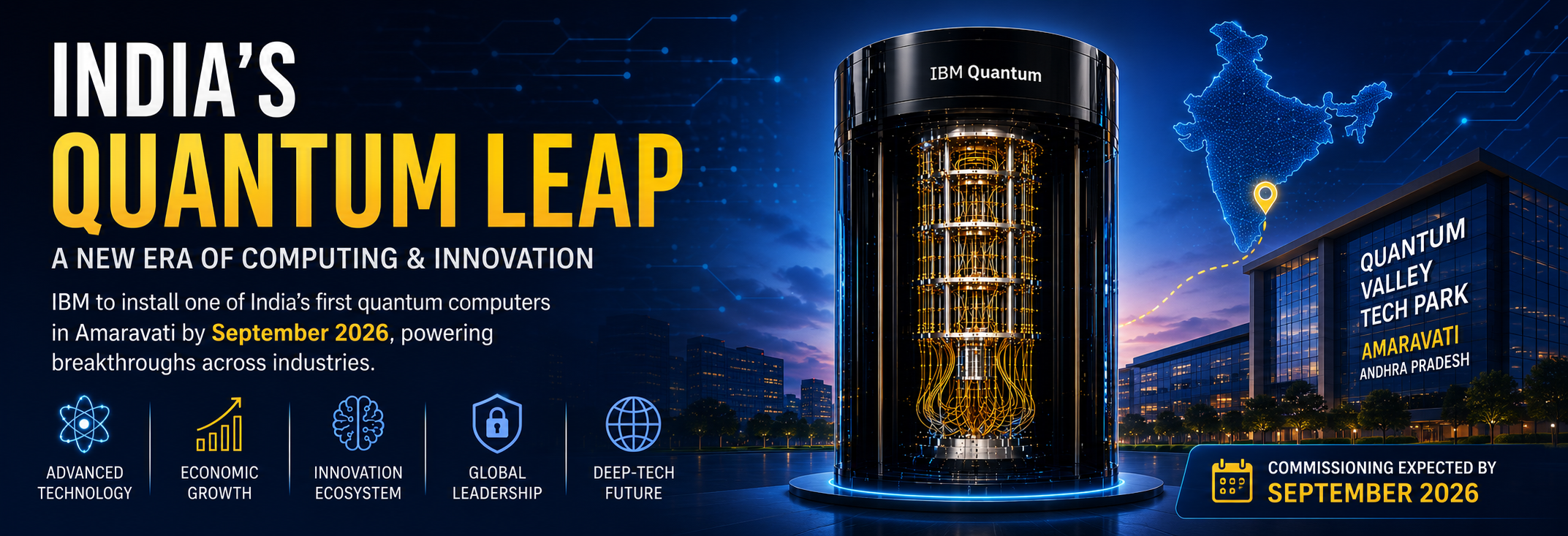
In a landmark announcement, IBM, in collaboration with Tata Consultancy Services (TCS) and the Government of Andhra Pradesh, plans to deploy IBM Quantum System Two, powered by IBM’s 156-qubit Heron processor, at the Quantum Valley Tech Park in Amaravati. The system is expected to be commissioned by September 2026.
This is more than the installation of a sophisticated machine. It represents a significant investment in India’s ambition to become a global leader in deep technology and advanced research.
What is Quantum Computing?
Traditional computers process information using bits, which can exist as either 0 or 1.
Quantum computers use qubits, which can represent multiple states simultaneously through the principles of quantum mechanics.
This enables quantum computers to solve certain classes of problems that would take today’s fastest supercomputers years—or even centuries—to complete.
It’s important to understand that quantum computers are not replacements for classical computers. Instead, they are specialized systems designed for highly complex computational challenges.
Why This Matters for India
The arrival of IBM Quantum System Two is expected to strengthen India’s growing quantum ecosystem.
Potential benefits include:
🤖 Artificial Intelligence
Quantum computing may help optimize machine learning algorithms and solve complex optimization problems faster.
💊 Drug Discovery
Researchers can simulate molecular interactions with greater precision, potentially reducing the time required to discover new medicines.
🔐 Cybersecurity
Quantum computing will accelerate the development of quantum-safe cryptography, an essential technology as existing encryption methods face future quantum threats.
📊 Financial Services
Banks and financial institutions could improve portfolio optimization, fraud detection, and risk modeling using quantum algorithms.
⚛️ Materials Science
Scientists can simulate new materials for batteries, semiconductors, and renewable energy systems more efficiently than ever before.
🌍 Climate & Scientific Research
Quantum computing has the potential to improve climate simulations, weather forecasting, logistics optimization, and advanced scientific research.
Beyond the Hardware: Building an Innovation Ecosystem
Perhaps the most exciting aspect of this initiative is not the quantum computer itself—but what it attracts.
World-class infrastructure often becomes the foundation for:
- Research institutions
- Universities
- Technology startups
- Global partnerships
- Venture capital investment
- High-skilled employment
Countries that invest early in emerging technologies often become global innovation hubs over the following decade.
A Reality Check
Quantum computing is still in its early stages.
While the technology is advancing rapidly, many commercial applications remain under development.
For most businesses:
- Cloud computing will continue to dominate.
- Classical servers will remain essential.
- AI workloads will largely continue running on GPUs and CPUs.
Quantum computers will complement—not replace—existing computing infrastructure.
What Technology Professionals Should Learn Today
If you’re a software engineer, architect, researcher, or technology leader, now is the right time to begin exploring:
- Quantum Computing Fundamentals
- Quantum Programming (Qiskit)
- Quantum Algorithms
- Quantum-safe Cryptography
- AI + Quantum Computing
- Hybrid Classical-Quantum Architectures
Early adopters often gain the biggest advantage when disruptive technologies become mainstream.
Looking Ahead
India’s digital transformation has accelerated through cloud computing, mobile technologies, fintech, and artificial intelligence.
Quantum computing may become the next pillar of this transformation.
The deployment of IBM Quantum System Two in Amaravati is not merely a technology announcement—it is a signal that India is investing in the future of scientific discovery, advanced computing, and deep-tech innovation.
While the commercial impact will take time to unfold, one thing is clear:
The countries that invest in quantum research today will help define the technological landscape of tomorrow.
Final Thoughts
The AI revolution has already transformed industries across the globe.
Now, the Quantum Revolution is beginning.
The question is no longer whether quantum computing will matter, but how prepared we will be when it does.
What are your thoughts?
Do you believe quantum computing will become as transformative as Artificial Intelligence over the next decade, or will it remain a specialized technology for research and niche industries?

